About Milky Way

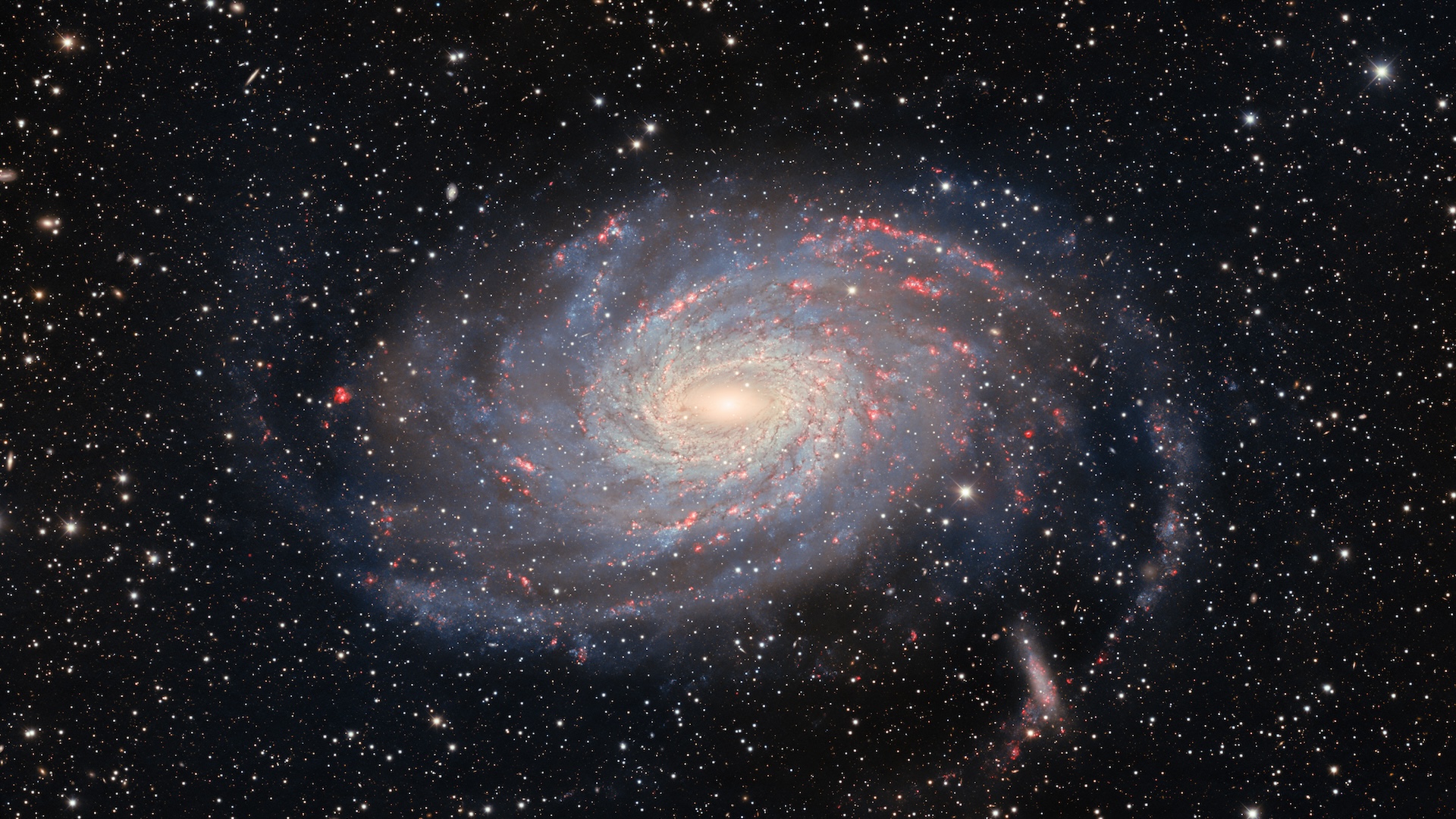
  • The Milky Way or Milky Way Galaxy[c] is the galaxy that includes the Solar System, with the name describing the galaxy's appearance from Earth: a hazy band of light seen in the night sky formed from stars in other arms of the galaxy, which are so far away that they cannot be individually distinguished by the naked eye.

  • The Milky Way is a barred spiral galaxy with a D25 isophotal diameter estimated at 26.8 ± 1.1 kiloparsecs (87,400 ± 3,600 light-years),[10] but only about 1,000 light-years thick at the spiral arms (more at the bar). Recent simulations suggest that a dark matter area, also containing some visible stars, may extend up to a diameter of almost 2 million light-years (613 kpc).[28][29] The Milky Way has several satellite galaxies and is part of the Local Group of galaxies, forming part of the Virgo Supercluster which is itself a component of the Laniakea Supercluster.

Interesting Facts about Milky Way

Mythology

  • In the Babylonian epic poem Enūma Eliš, the Milky Way is created from the severed tail of the primeval salt water dragon Tiamat, set in the sky by Marduk, the Babylonian national god, after slaying her.[42][43] This story was once thought to have been based on an older Sumerian version in which Tiamat is instead slain by Enlil of Nippur,[44][45] but is now thought to be purely an invention of Babylonian propagandists with the intention of showing Marduk as superior to the Sumerian deities.

Etymology

  • In Greek mythology, Zeus places Heracles, his infant son born to Alcmene, on Hera's breast while she is asleep so the baby will drink her divine milk and become immortal. Hera wakes up while breastfeeding and then realizes she is nursing an unknown baby: she pushes the baby away, some of her milk spills, and it produces the band of light known as the Milky Way.[46] In another Greek story, the abandoned Heracles is given by Athena to Hera for feeding, but Heracles' forcefulness causes Hera to rip him from her breast in pain.